Terence Greene
The People UpstairsTerence Greene is the Earth-born child of May Greene and Dan Greene, and his existence turns a covert colonial strategy into an intimate crisis of identity. Conceived as proof that agents born within Earth’s culture could operate more naturally than trained outsiders, he is at once a child, a concealed alien, a prospective Milotan agent, and—because he was born in the United States of America—the first Milotan on Earth who requires no forged papers. His legal belonging and bodily otherness never coincide, making him the story’s clearest embodiment of the conflict between citizenship, culture, and physical identity.
Identity and Birth
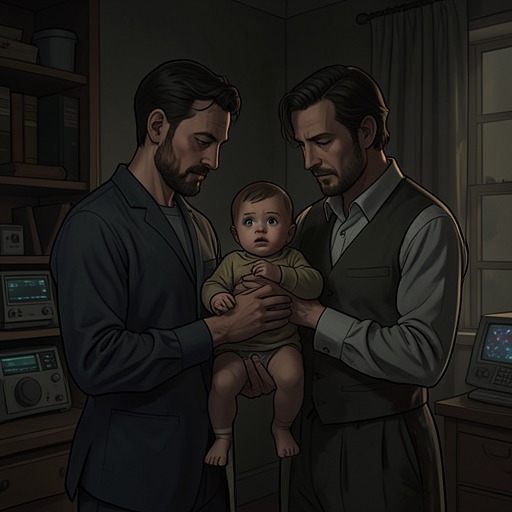
Terence is born eight months after May Greene’s unexpected pregnancy, following a crisis in which his parents consider returning to Milotis in disgrace. Their adaptations have made them unable to return comfortably to their home planet, while their work as secret agents requires them to remain inconspicuous on Earth. The possibility of raising a child born into Earth’s culture offers both a personal hope and a strategic argument: a native-born agent might understand terrestrial customs so completely that he could not make the slips that endanger conventionally trained infiltrators.
His birth therefore has an institutional meaning beyond the family. Terence is born on Earth, in the United States of America, and receives a bona fide birth certificate, making him technically not even a Milotan in the legal classification described by the narrative. Yet this formal status does not make his life ordinary. Dr. Robinson must fit him with masks and contact lenses, and the disguises must be repeatedly managed as he grows. The contrast is exact: the child possesses authentic Earth documentation while the visible body presented to Earth society is manufactured.
Childhood Under Disguise
Dr. Robinson’s disguises are especially burdensome because a child has more exposed and rapidly changing surfaces than an adult. Terence’s masks, lenses, and coverings are expensive, and Milotan children grow more slowly than terrestrial children, which gives the family some additional time but does not remove the financial strain. The Greenes cannot afford to maintain their former comforts. May gives up her income to stay home with him, Dan continues working, and the family abandons imported tobacco, delicacies from Milotis, luxuries, and eventually necessities.
The domestic labor also exposes the distance between the parents’ expectations and the reality of raising Terence on Earth. On Milotis, robots would have cared for a baby, but the technologically inferior setting forces May to perform the child care herself. Milotan babies cry like terrestrial babies, and their physical needs are equally demanding. May’s investment is practical, financial, and emotional, but it is complicated by guilt: she had confidently expected motherhood to bring pleasure, sometimes finds the experience unrewarding, and then compensates by giving Terence things he wants even when they are not good for him.
Terence’s early development is interpreted through terrestrial assumptions. He does not walk until he is two or speak until he is three, so the neighbors regard him as backward. May is inwardly angry but cannot reveal that his development is normal for a Milotan child; prolonged residence on Earth has also conditioned her enough that she begins, in some sense, to accept the local judgment. The child is thus seen through a false medical and cultural frame before he can explain himself.
Education and Emerging Identification
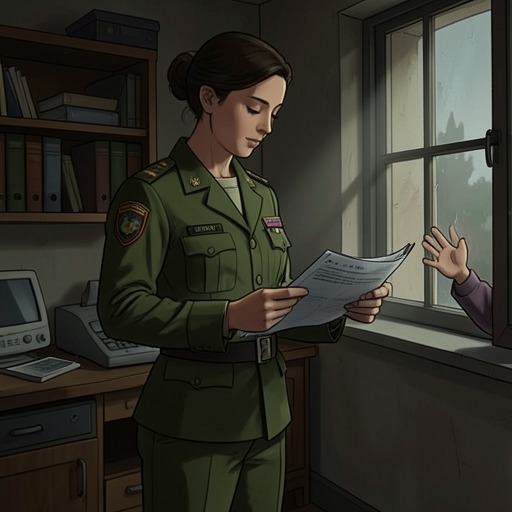
When Terence reaches six, compulsory attendance makes concealment more difficult. A tutor would draw attention to the Greenes’ supposedly average middle-class life, and keeping him permanently at home would violate the law. May enrolls him in a private day school and tells the principal that the Greenes are Christian Scientists, using the claimed religious position to prevent medical examinations. The arrangement protects the disguise but places Terence inside an institution whose ordinary procedures are potentially dangerous to him.
Terence is capable of holding his own academically. Although he would be developmentally younger by Milotan standards, Milotan children have stronger learning aptitudes, and he is self-possessed because he has spent most of his time with adults. His parents deliberately hope he will do well without becoming conspicuously brilliant: exceptional ability would attract precisely the attention their concealment is designed to avoid. His marks remain good but not outstanding, a carefully fortunate middle position.
His first school experience seems uneventful, but his questions reveal that he is already comparing bodies. After noticing that his classmates and teachers do not wear face masks or lenses, he asks why his family is different. His parents initially tell him only that they come from a far-off place, postponing the explanation because they doubt his discretion. They speak both Milotan and English at home, teach him both languages, and warn him never to speak Milotan in public, while limiting his contact with other children.
That limited social world makes Earth culture increasingly authoritative. Terence is allowed to bring home an occasional friend, but his parents do not encourage such visits. They compensate by taking him to theaters, museums, and the zoo, hoping to prevent him from longing for juvenile companionship or noticing how few relationships he has with children his own age. His school’s prissy atmosphere is also fortunate because it lacks rough organized sports that could damage the coverings on his face, arms, and legs.
Rejection of Milotis
The Greenes try to preserve Terence’s connection with Milotis through language, geography, and history, but he responds by treating the material as a joke or by refusing it altogether. He first becomes embarrassed by Milotan and then refuses to speak it. When Dan corrects his description of the language, Terence treats Milotan as equivalent to Esperanto and proudly announces that students with linguistic aptitude will begin French the following term. His aspiration is not merely academic; it signals a desire to be legible as an Earth child rather than marked as different.
Dan recognizes the danger and tells May that the boy is identifying with the terrestrial population. Terence pretends not to understand Milotan because he does not want to be different. His parents, however, interpret difference in opposite emotional registers. For Dan, Terence’s Earth identification threatens the purpose for which he was born and raises the cost of his education; for May, it is an unavoidable fact that he will eventually have to confront. The parents’ own wish that the Milotan Bureau will someday acknowledge him and provide an allowance contrasts with the child’s wish to remain unexceptional on Earth.
The delayed revelation intensifies this conflict. After Terence has begun to succeed at school, May and Dan wait several weeks before telling him the truth, reluctant to halt his adjustment. When Dan finally explains that they come from another planet and another solar system, Terence initially tries to fit the information into familiar categories. He guesses Russia, then China, asking whether Chinese people wear masks and objecting that they are yellow rather than green. His guesses show that he can imagine foreignness only through Earth’s geography and racial assumptions; the scale of his own difference exceeds the categories available to him.
Exposure and Awakening
The decisive rupture comes through swimming lessons. Terence is summoned from the principal’s office anteroom with opaque contact lenses filled with tears, and he has no apparent relief at seeing May. He struggles to explain that the class has begun swimming lessons, an activity that makes concealment impossible. The school that seemed genteel and minimally alien has suddenly required exposure of the body beneath the disguise.
Terence names the result with devastating directness: he tells May that he is different, and the statement functions as an accusation. He understands that the difference is not a minor family eccentricity but a condition imposed by his parents and hidden from him. The swimming lesson converts an abstract warning into bodily knowledge. Face masks and lenses had allowed him to ask whether other people wore disguises; compulsory undress forces him to recognize that the disguise belongs to him alone.
The principal excludes him from the school and urges May to tell the authorities what is wrong with him before enrolling him elsewhere. May maintains the family’s cover, saying that the Greenes may move from Washington Heights to the suburbs and transfer Terence to a school where nobody will know. Her response is outwardly courteous and privately triumphant: the school’s rejection has not ended the concealment, but it has finally broken Terence’s confidence that the story of his origin was invented.
Recognition and Future Mission
After leaving the school, Terence clings tightly to May’s hand throughout the walk to the car, creating a closeness between them that she has not felt since he was an infant. The physical gesture marks a change in their relationship. He is no longer simply the child whose body must be protected and whose education must be managed; he has become someone actively seeking an account of himself, and May must answer him as a mother rather than merely as an agent.
For half the journey he remains silent, then asks in halting Milotan whether Milotis truly exists and whether everyone there is like them. His question shows that the rejected language has become a path toward knowledge rather than an embarrassment. He also wonders whether his parents invented Milotis merely to explain his difference. May confirms that the planet is real and promises to tell him about it at home.
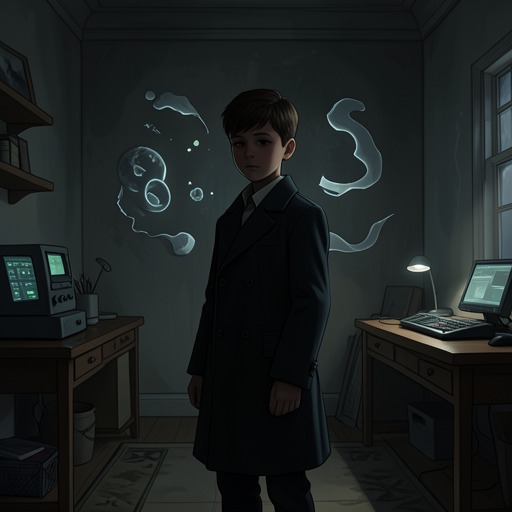
The ending joins emotional recognition to political consequence. May pats the plastoskin covering his small, mutilated hand and tells him that they will send a beam to Milotis describing him. Terence’s concealed life is therefore about to become an official report, transforming the child who was meant to prove the Bureau’s native-born strategy into its first concrete result. His Earth birth has given him authentic civic status, his school experience has shown him the limits of social inclusion, and his parents’ disclosure begins a new phase in which he may have to inhabit both worlds consciously rather than passively receiving either identity.